Feasibility Study Confirms PEA Project Capital and Lowest-Quartile
Operating Costs
All monetary amounts are in U.S. dollars, unless otherwise indicated.
Toronto, ON: Global Atomic Corporation (“Global Atomic”
or the “Company”), (TSX: GLO, OTCQX: GLATF, FRANKFURT: G12) announced today
the results of the Phase 1 Dasa Project Feasibility Study (the “Study”) for
the Company’s Dasa Uranium Project (the “Project”) in the Republic of
Niger.
The Study confirms that the Project is
economically compelling, even at a price of $35 per pound
U3O8. Based on the Study, the strong uranium
market and anticipated uranium supply deficits, the Board of Directors have
made a production decision to proceed with the Dasa Project. The
Study is focused solely on Phase 1, primarily comprised of the Flank Zone, and
represents the initial 12 years of the Project and less than 20% of the Dasa
mineralization, which has been delineated through 160,000 metres of drilling
since 2010. The Study is an update from the Preliminary Economic
Assessment (the “PEA”) filed in May 2020.
The Dasa
Project is located in Niger’s Tim Mersoï Basin, which has successfully
produced uranium for export to France, the United States and other countries
for 50 years, contributing to Niger’s status as the 5th largest
exporter of U3O8 for use in nuclear power plants.
HIGHLIGHTS
- Study Base Case price is $35 per pound U3O8
- After-tax NPV8 of $157 million and after-tax IRR of 22.7%
- Cash cost(1) of $18.91 per pound
- All-in sustaining cost(2) of $21.93 per pound
- Steady-state mill recovery rate of 94.15%
-
Average annual steady-state uranium production of 3.8 million pounds
U3O8
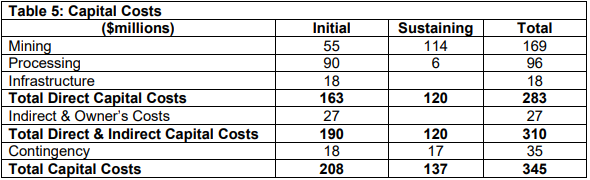
- $208 million capital costs include a 10% contingency
-
Mining reserve of 4.3 million tonnes grading 5,184 ppm U3O8
-
Recovering 45.4 million pounds U3O8 over 12 years

Stephen G. Roman, President and CEO commented, “We are pleased to report our Maiden Reserve and confirm robust economics
for the Dasa Project. We had already decided to move ahead with
construction contracts to break ground in January 2022 and begin underground
development in April 2022. We are now ready to negotiate project
financing, advance offtake negotiations with utilities, complete detailed
engineering and complete the bidding process for an EPCM contract to build
and commission our processing plant by the end of 2024.”
“The mining industry has seen significant pandemic-induced increases in
input costs since the PEA was completed in 2020. We are very
pleased to have duplicated our previous PEA project capital costs and thank
METC Engineering, Bara Consulting, Insight R&D and Process Research
Ortech for their excellent work in this regard. In the event pandemic
related cost increases return to historical levels, project economics will
be further enhanced.”
Feasibility Study Overview and Comparison to the Preliminary Economic
Assessment
he objective of the Study was to confirm the findings of the May
2020 PEA, apply detailed design and current costing to the Project, and reduce
the risks of the Project thus decreasing the previously applied 20%
contingency rates. The Study proves the viability of the Project
and will serve as the basis for the Company to negotiate project financing,
advance off-take agreement discussions with utilities, finalize detailed
engineering and select an EPCM contractor to build the processing
plant.
Table 1 below compares key metrics from the PEA
to the Study.

With the issuance of the Dasa Mining Permit and an Environmental
Compliance Certificate by the Republic of Niger, the Dasa Project is fully
permitted for commercial production. Excavation of the Box-Cut and collaring
of the mine Portal are planned for early 2022.
Economics
The Study was completed to Class 3 Standards of the Association
for the Advancement of Cost Engineering (“AACE”) and has an accuracy of +/-
9.6%.
The economic analysis for the Study was done with a
discounted cash flow (“DCF”) model based on a uranium price of $35 per pound
U3O8. The discount rate used for the base-case analysis
is 8% (“NPV8”). Sensitivity analysis was applied at intervals from
$35 per pound to $60 per pound, as shown in Table 2 below.

The DCF includes the current tax regime and royalty requirements
in Niger. Net present value (“NPV”) figures are calculated using a range
of discount rates as shown in Table 3.

The Study is focused solely on Phase 1, which represents the
initial 12 years of the Project. The longitudinal section of the
Dasa Deposit (see Figure 1 below) highlights the Flank Zone area being mined
in Phase 1 (within the solid red-lined square), representing less than 20% of
the Dasa mineralization. After Phase 1, the Company plans to
continue with the underground mining of Phase 2 and after several decades
consider an open-pit operation to mine the lower-grade surface mineralization
of Phase 3.

Global Atomic Declares Maiden Mineral Reserves
The Mineral Resource Estimate (“MRE”) prepared by CSA
Global with an effective date of June 1, 2019 is used as the basis for the
Study. Economic analysis, including a cut-off grade of 2,074 ppm
U3O8 based on a U3O8 price of $35
per pound, was applied to the Indicated Resources of the MRE, comprising
primarily the Flank Zone. A resultant Phase 1 Mine Plan was developed for the
Dasa deposit to yield the following reserves:
Processing
The Project will use operationally proven uranium processing
techniques, comprised of dry SAG grinding and classification; pug-leaching and
curing; uranium extraction circuit (re-pulping and solid/liquid separation);
uranium purification and precipitation circuit; drying and packaging. Based on
extensive metallurgical work and a six-month pilot plant study, a steady-state
recovery rate of 94.15% is estimated over the12-year mine plan of the Project,
which is expected to produce 45.4 million pounds of U3O8 as Yellowcake.
Operating Costs

The cash cost of $18.91 per pound places Dasa in the lowest
quartile of uranium companies.
Capital Costs
Project Financing
In April 2021, Global Atomic engaged London-based HCF
International Advisers (“HCF”) to assist in project financing. HCF
specializes in financing mining projects in Africa. With HCF, the
Company has short-listed a group of banks and financial institutions who
are interested in funding the Project. With the application of
cash flow from the Company’s Turkish Zinc JV and the potential to Direct Ship
Ore (“DSO”) to Orano Mining’s Somaïr processing facility in Niger to generate
revenue during the development stages of the Dasa mine, the Company plans to
minimize the amount of equity required for project financing. With
the completion of the Study, the Company expects to accelerate these financing
discussions and conclude a financing agreement in the first half of 2022.
Value Opportunities
In 2021, the Company has been actively engaged in discussions
with Orano Mining regarding the potential of a DSO arrangement with their
Somaïr processing plant, situated approximately 100 kilometers north of the
Dasa Project. Orano Mining processed samples of Dasa ore through
the Somaïr plant in a series of successful metallurgical tests earlier in
2021. The Memorandum of Understanding signed with Orano in 2017 included the
shipment and sale of 500,000 tonnes of ore to Somaïr within the initial
five-year period of mining at Dasa. By the end of 2024, Global Atomic intends
to commission its own plant to process ore from Dasa. Discussions have since
been expanded to include the option of toll milling, combining certain
logistics and shipping Yellowcake to Global Atomic customers.
One
of the objectives of the 15,000-meter drilling program that began in September
2021, is to explore extensions of the Flank Zone located close to surface
which could result in extending the mining of shallow ore, thereby lowering
development and operating costs for the Project.
Currently, the
Phase 1 Mine Plan is focused on mining the Flank Zone area which comprises
approximately 80% of U3O8 pounds mined. The Phase 1 Mine
Plan also took into account more remote locations as depicted in Figure 2.

The areas referred to as Zones 3, 4 and 5 had sufficient drill
density to be classified as Indicated Resources, thereby enabling them to be
converted into Probable Reserves. As further drilling upgrades the Inferred
Resources around Zones 1 and 2, Global Atomic expects mining would continue in
these areas, which would require less development, thereby reducing costs
associated with mining Zones 3, 4 and 5 until mining progressed to these areas
in the natural course of mine development over succeeding years. Figure 3
shows the distribution of Indicated and Inferred Resources throughout the Dasa
deposit.

Presently, the Company is infill drilling an area referred to as
Zone 2 East, which is above Zone 3. The drilling density in this area was only
sufficient to classify it as Inferred Resources. A previously drilled hole
adjacent to the current drilling is ASDH 476, which contained a 100 meter
section averaging 3,497 ppm, including a higher grade portion with a width of
50 meters and a grade of 5,972 ppm.
A NI 43-101 compliant technical
report related to the Feasibility Study will be filed on SEDAR and posted to
the Company website (www.globalatomiccorp.com) by December 30, 2021.
QP Statement
The
scientific and technical disclosures in this news release have been reviewed
and approved by Andrew Pooley and John Edwards. Andrew Pooley is the
Managing Director of Bara Consulting. He has obtained a B.Eng (Hons) in Mining
Engineering from Nottingham University in the UK, he is a Fellow of the
Southern African Institute of Mining and Metallurgy, and has over 25 years of
experience in the mining industry. John Edwards is a Professional Metallurgist
and is the Chief Metallurgist at METC Engineering Pty Ltd. having graduated
with a BSc Hons in Mineral Processing Technology in 1985 from Camborne School
of Mines, UK. He is a Fellow of the Southern African Institute of Mining and
Metallurgy with over 35 years of experience as a metallurgist.
About Global Atomic
Global Atomic Corporation (www.globalatomiccorp.com) is a publicly listed company that provides a unique combination of
high-grade uranium mine development and cash-flowing zinc concentrate
production.
The Company’s Uranium Division includes four deposits
with the flagship project being the large, high grade Dasa Project, discovered
in 2010 by Global Atomic geologists through grassroots field exploration. With
the issuance of the Dasa Mining Permit and an Environmental Compliance
Certificate by the Republic of Niger, the Dasa Project is fully permitted for
commercial production.
Global Atomics’ Base Metals
Division holds a 49% interest in the Befesa Silvermet Turkey, S.L. (“BST”)
Joint Venture, which operates a modern zinc production plant, located in
Iskenderun, Turkey. The plant recovers zinc from Electric Arc Furnace Dust
(“EAFD”) to produce a high-grade zinc oxide concentrate which is sold to zinc
smelters around the world. The Company’s joint venture partner, Befesa Zinc
S.A.U. (“Befesa”) listed on the Frankfurt exchange under ‘BFSA’, holds a 51%
interest in and is the operator of the BST Joint Venture. Befesa is a market
leader in EAFD recycling, with approximately 50% of the European EAFD market
and facilities located throughout Europe, Asia and the United States of
America.
Key Contacts
Stephen G. Roman
Chairman, President and CEO
Tel: +1 (416)
368-3949
Email:
sgr@globalatomiccorp.com
Bob Tait
VP Investor Relations
Tel: +1 (416) 558-3858
Email:
bt@globalatomiccorp.com
The information in this release may contain forward-looking information under
applicable securities laws. Forward-looking information includes, but is
not limited to, statements with respect to completion of any financings;
Global Atomics’ development potential and timetable of its operations,
development and exploration assets; Global Atomics’ ability to raise
additional funds necessary; the future price of uranium; the estimation of
mineral reserves and resources; conclusions of economic evaluation; the
realization of mineral reserve estimates; the timing and amount of estimated
future production, development and exploration; cost of future activities;
capital and operating expenditures; success of exploration activities; mining
or processing issues; currency exchange rates; government regulation of mining
operations; and environmental and permitting risks. Generally,
forward-looking statements can be identified by the use of forward-looking
terminology such as “plans”, “is expected”, “estimates”, variations of such
words and phrases or statements that certain actions, events or results
“could”, “would”, “might”, “will be taken”, “will begin”, “will include”, “are
expected”, “occur” or “be achieved”. All information contained in this
news release, other than statements of current or historical fact, is
forward-looking information. Statements of forward-looking
information are subject to known and unknown risks, uncertainties and other
factors that may cause the actual results, level of activity, performance or
achievements of Global Atomic to be materially different from those expressed
or implied by such forward-looking statements, including but not limited to
those risks described in the annual information form of Global Atomic and in
its public documents filed on SEDAR from time to time.
Forward-looking statements are based on the opinions and estimates of
management at the date such statements are made. Although management of
Global Atomic has attempted to identify important factors that could cause
actual results to be materially different from those forward-looking
statements, there may be other factors that cause results not to be as
anticipated, estimated or intended. There can be no assurance that such
statements will prove to be accurate, as actual results and future events
could differ materially from those anticipated in such statements.
Accordingly, readers should not place undue reliance upon forward-looking
statements. Global Atomic does not undertake to update any
forward-looking statements, except in accordance with applicable securities
law. Readers should also review the risks and uncertainties sections of
Global Atomics’ annual and interim MD&As.
The Toronto Stock Exchange has not reviewed and does not accept responsibility
for the adequacy and accuracy of this news release.